
Nikro Air Duct Cleaning in Cypress: A Homeowner’s Guide
Most homeowners watch a Nikro machine roll up the driveway and assume the job is being done right. Here’s the part that matters: the machine does nothing on its own. A Nikro negative-pressure system only works when it’s set up correctly against your specific duct layout, with collection points placed by hand and moved through the system as the work progresses. A truck full of equipment proves nothing. What proves it is how the technician deploys that equipment inside your house. This guide covers what a Nikro system actually does, how it should be set up in Cypress homes, and what to look for before you sign a work order.
If you’d rather leave the ductwork to someone who does this every day, call (833) 698-8235. We answer 24/7, and fast dispatch runs from 7am to 7pm, Sunday through Friday.
What does a Nikro negative-pressure system actually do?
A Nikro duct cleaning system is a high-powered vacuum built to hold an entire duct network under continuous negative pressure while the technician disturbs dust, debris, and settled particulate from inside. That’s the mechanical difference between a real duct cleaning and a shop-vac pass. A shop vac pulls air at the nozzle. A Nikro unit pulls air across the whole system, so loosened debris travels toward the collection point instead of drifting into your living room.
Two ratings do the actual work:
- Airflow (CFM): This is how much air the machine can move per minute. Higher CFM lets the system maintain suction across longer duct runs, which matters in larger Cypress homes where the trunk line splits into several branches.
- Static pressure and lift: This is the machine’s ability to hold suction against resistance: filter media, flex duct, elbows, and tight turns. A vacuum with strong airflow but weak lift loses its grip deep in the system, right where most debris settles.
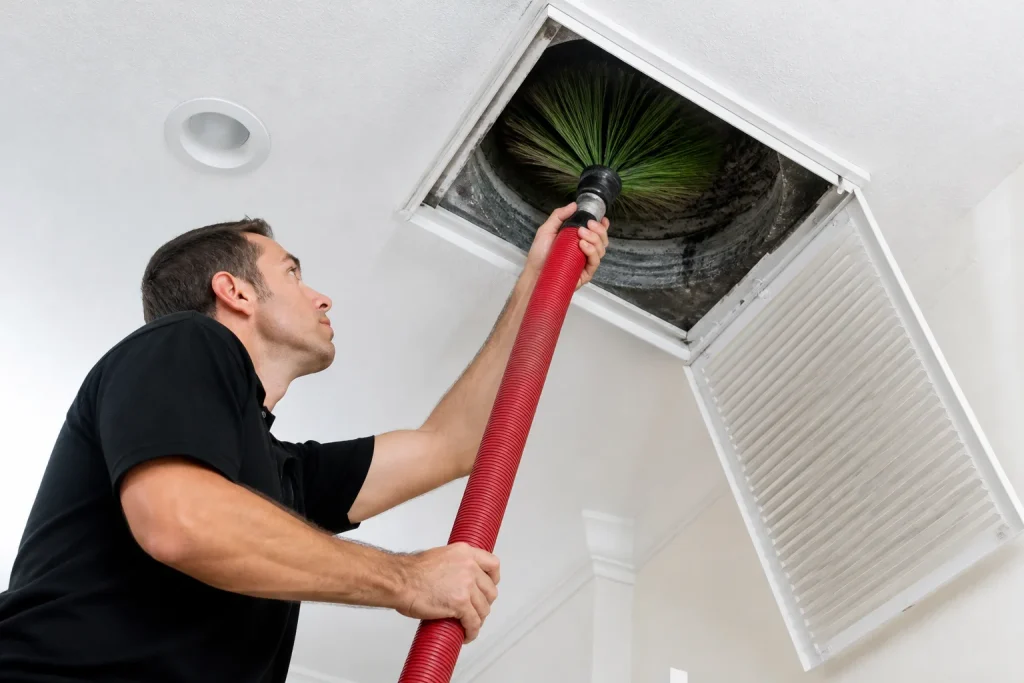
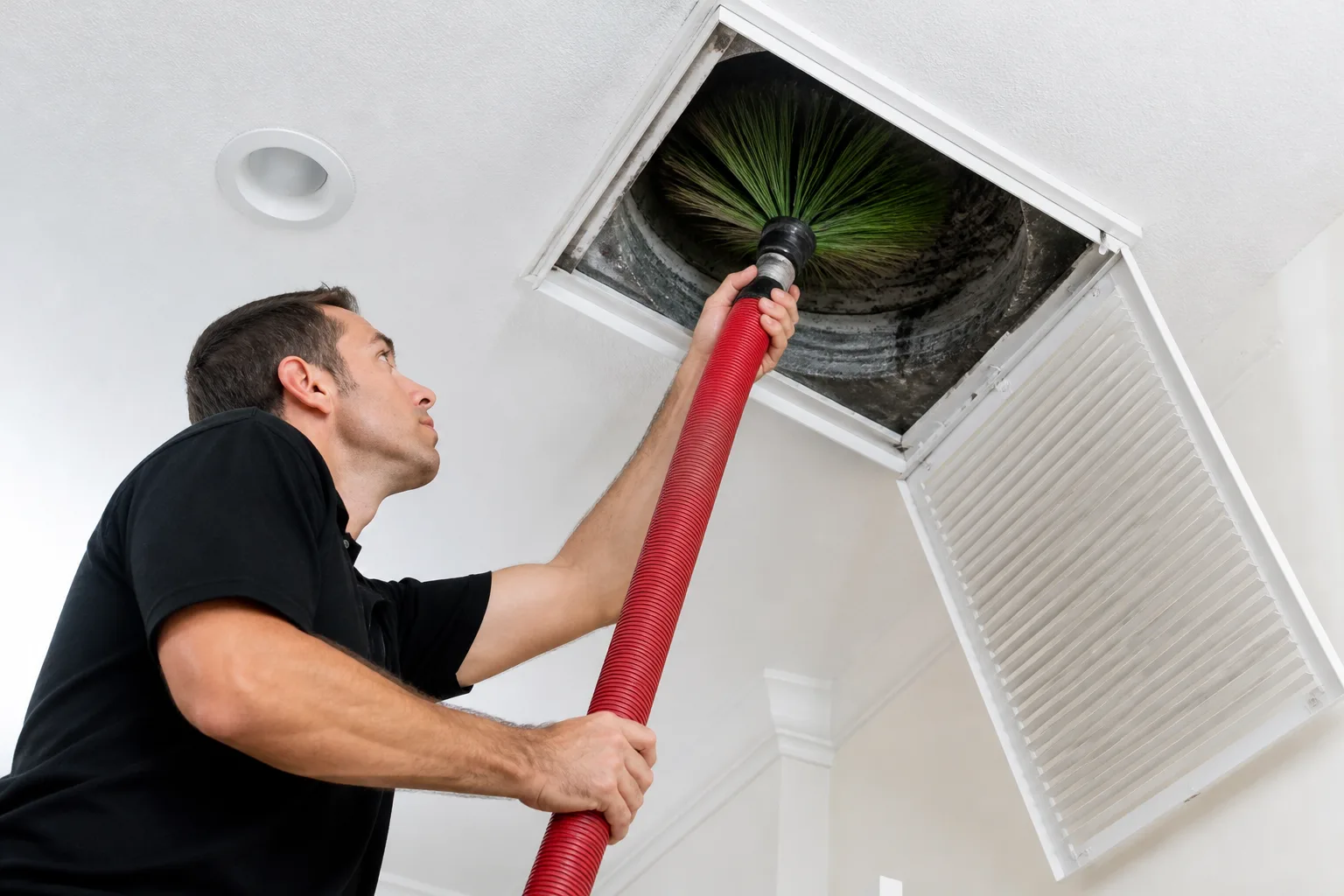
Professional-grade equipment is what separates a thorough cleaning from a surface one. Our technicians have up to 12 years of experience, and they use Rotobrush and Nikro systems, the same category of equipment HVAC specialists rely on. A Nikro machine paired with the right agitation tools (whips, brushes, and air-driven devices) is what loosens caked dust from duct walls so the vacuum can carry it away.
How should Nikro equipment be set up in a Cypress home?
The access point setup changes with the house. Cypress has a good mix of single-story slab homes and two-story tract homes, and the duct layout is often the reason two identical-looking cleaning jobs produce very different results. Getting the setup right is half the job; the other half is placing every access point where the vacuum can reach the full run.
For a single-story slab home, ductwork usually runs in the attic or through a soffit chase, with a central return. The technician should connect the Nikro unit to the main trunk at a point that lets the vacuum pull from the farthest branch, then work inward. Cutting access holes is sometimes necessary. Those holes should be sealed afterward, and you should be able to see where the sealing happened.
For a two-story home with attic ductwork, the return usually sits central and the branches spread outward across the attic floor. The machine needs to pull from the return while the technician works each branch, sometimes moving the vacuum connection mid-job to hold negative pressure in the section being cleaned.
If your ducts are lined with flex duct rather than rigid metal, ask how the technician will handle it. Aggressive brushing on flex duct can tear the inner liner, and a torn liner is a leak you’ll be breathing through for years. Abatement Technologies containment equipment, which we use on jobs where particulate control matters, keeps dust from escaping into the living space during the work.
Why isn’t a Nikro machine a “set and forget” tool?
Because it isn’t. A Nikro unit holds negative pressure, but negative pressure at one point only cleans the section connected to that point. The technician has to reach into each branch, agitate the dust, and then move the collection point so the loosened material travels toward the vacuum. That means:
- Choosing where to connect the vacuum for the run being cleaned.
- Isolating a section by moving or blocking dampers where possible.
- Agitating the duct walls with the right tool for that duct material.
- Pulling the loosened debris toward the vacuum.
- Repeating for each branch, then sealing access points.
This is why the job takes time. A technician who connects the vacuum once, runs a brush through a couple of registers, and leaves has technically used a Nikro machine. The machine was present. The work wasn’t done. In our experience, this is the single most common shortcut in the trade, and it’s exactly what a homeowner can’t see from the front lawn. In a dry climate like Cypress, where fine dust settles deeper and packs tighter, that shortcut is even more visible in the results.
What should you check on the work order to confirm Nikro equipment was used correctly?
Ask for specifics, not a brochure. A work order that confirms real work reads like a record of what happened, not a receipt. Here’s what to look for:
- Equipment model noted: The specific Nikro (or Rotobrush) system used, not a generic “vacuum” line.
- Access points listed: How many were cut, where, and how they were sealed afterward. If the technician opened a duct, the work order should say so.
- Before-and-after photos: A photo of the duct interior before cleaning and after, with the equipment in place. We provide photos of your own ducts, not stock images.
- Line items per system: A flat price per system agreed before work starts, not a per-vent figure that balloons once the technician is on site.
- Any repair or sealing done: If ductwork was repaired or sealed, it should be described on the work order.
If a company can’t show you what was done, that’s your answer. The tool doesn’t confirm the work; the record does. And if a quote is far lower than every other quote you receive, ask what’s excluded. The low price is often the version of the job where the machine was present but never moved.
How does Cypress’s dry climate and stucco construction affect your ducts?
Cypress sits in a warm, dry corner of Southern California. Winters are mild and summers are long and dry, which means interior dust tends to be fine and powdery rather than damp and clumped. Fine dust settles deeper into the low points of a duct run and clings to duct walls, so an agitation step that relies on moisture or heavy brushing won’t do it. You need equipment with real airflow and lift to pull that dust out, plus a technician patient enough to work each section.
Stucco construction matters too. Stucco walls and the plaster inside them shed a small amount of fine silicate dust over time. In a tightly sealed home with the AC running most of the year, that dust cycles through the return and lands in your ductwork. It isn’t dangerous in small amounts, but it’s the reason ducts in older Cypress homes look worse than the homeowner expects when they finally pull a register cover. That’s the environment where equipment selection actually matters: a high-CFM, high-lift Nikro system does real work in this climate, and a shop vac caught up in a truck bed does not.
Once the ducts are clean, keeping them that way is a matter of sealing leaks and, if your home is prone to airborne allergens, adding a filtration layer. We install Honeywell and Aprilaire air-quality products, and Guardsman protective treatments can extend the life of a freshly cleaned system. Clean ducts are only the beginning.
When to call a pro
If you’re noticing dust settling on furniture faster than usual, musty odors when the air comes on, or visible debris around the registers, it’s worth a professional inspection. The same is true if you’ve just moved into an older Cypress home and don’t know when the ducts were last cleaned. Duct repair and sealing are also worth a call if you suspect leaks; we don’t just clean, we inspect, repair, and seal. A quick call will tell you whether you’re due.
Related services in Cypress
We handle air duct cleaning as the core service, plus dryer vent cleaning (a lint buildup you can’t see), HVAC cleaning, duct repair and sealing, and air sanitizing. Most households don’t need a second vendor for any of it. You can learn more about how we work at Cypress Air Duct Cleaning Pros.
The Bottom Line
A Nikro system is a genuine piece of professional equipment, but it’s only as good as the setup around it. The correct access points, the right agitation tools for your duct material, collection points moved branch by branch, and a work order that documents all of it. In Cypress, that combination is the difference between a cleaning that actually happens and one that was technically performed.
If you’re in Cypress and need help, Cypress Air Duct Cleaning Pros offers free estimates. Call (833) 698-8235. We answer 24/7. Fast dispatch from 7am to 7pm, Sunday through Friday. Every job is one flat price per system, agreed before work starts, with before-and-after photos. The local pro we connect you with is licensed and insured as their state requires.
Frequently Asked Questions
Yes, by a wide margin. A Nikro unit holds the entire duct system under negative pressure and pulls loosened debris toward the collection point, while a shop vac only pulls air at the nozzle and leaves settled dust behind. Airflow and static pressure ratings on a Nikro system are built for long duct runs; a shop vac is not. Call (833) 698-8235 for a free estimate.
Ask for the work order with the equipment model noted, the access points listed, and before-and-after photos of your own ducts. A machine in the driveway proves nothing. The record of what was done inside the ducts does. Call (833) 698-8235 if you’d like to see what a real work order looks like.
Most homes do fine with cleaning every few years, but it depends on your situation. Homes with pets, allergy sufferers, recent renovations, or older ductwork tend to need it more often. If you can see dust buildup around the registers, it’s time for a look. Call (833) 698-8235 for a free estimate.
Because the cheap quote often skips the part that takes time: moving the vacuum connection branch by branch, agitating each section, and sealing access points afterward. A low price sometimes means the machine was present but never moved. We charge one flat price per system, agreed before work starts. Call (833) 698-8235 for an honest quote.
Written by the team at Cypress Air Duct Cleaning Pros.
Need Air Duct Cleaning Help?
Call Cypress Air Duct Cleaning Pros - the local pro we connect you with is licensed and insured, with free written estimates in Cypress.
(833) 698-8235